
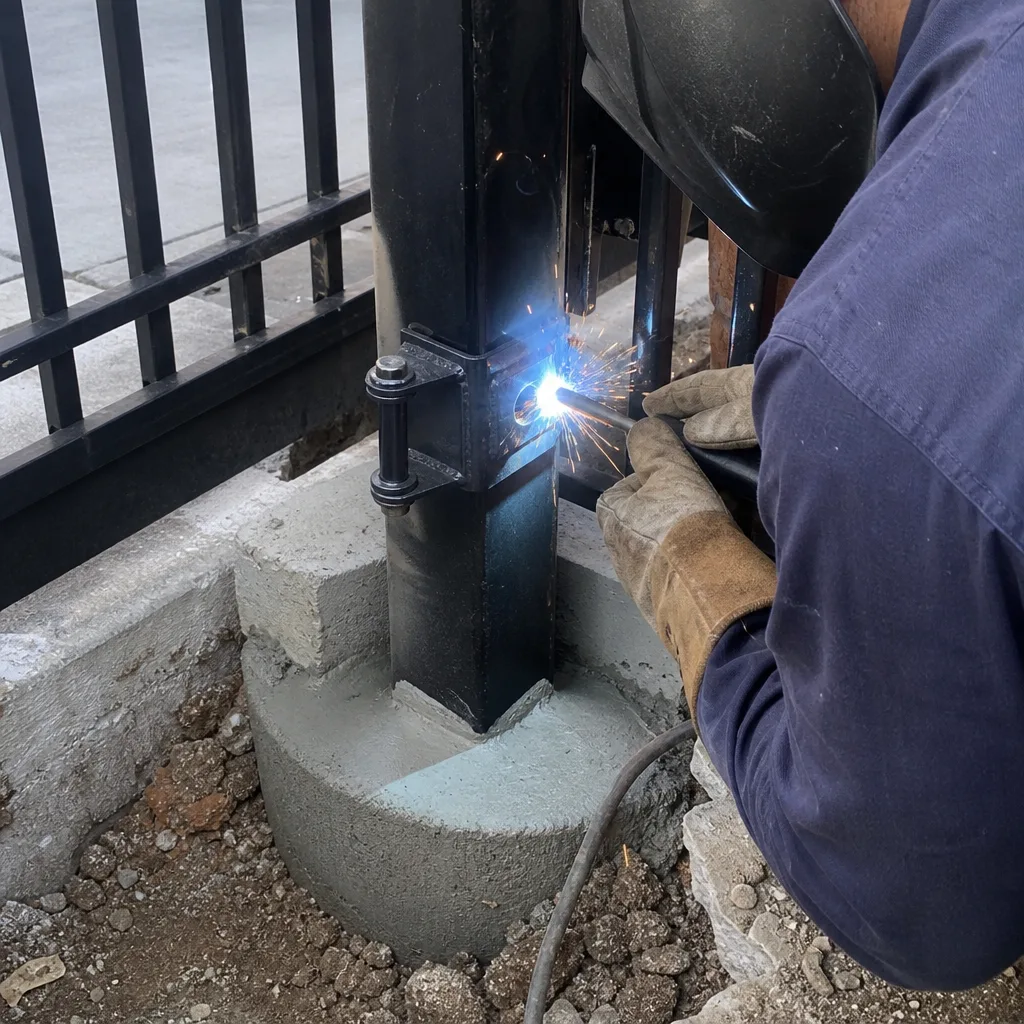
Last updated October 16, 2026
 Wrought iron
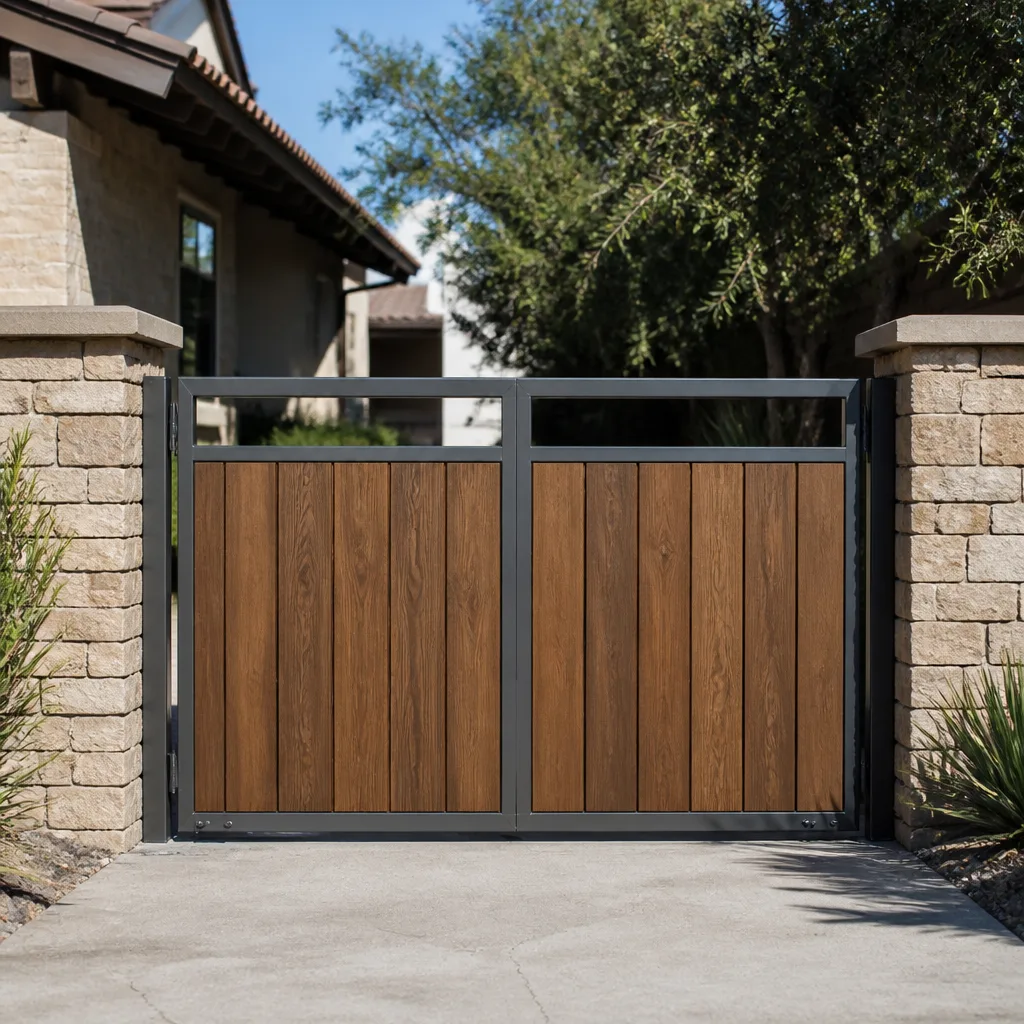 Wood & steel frame
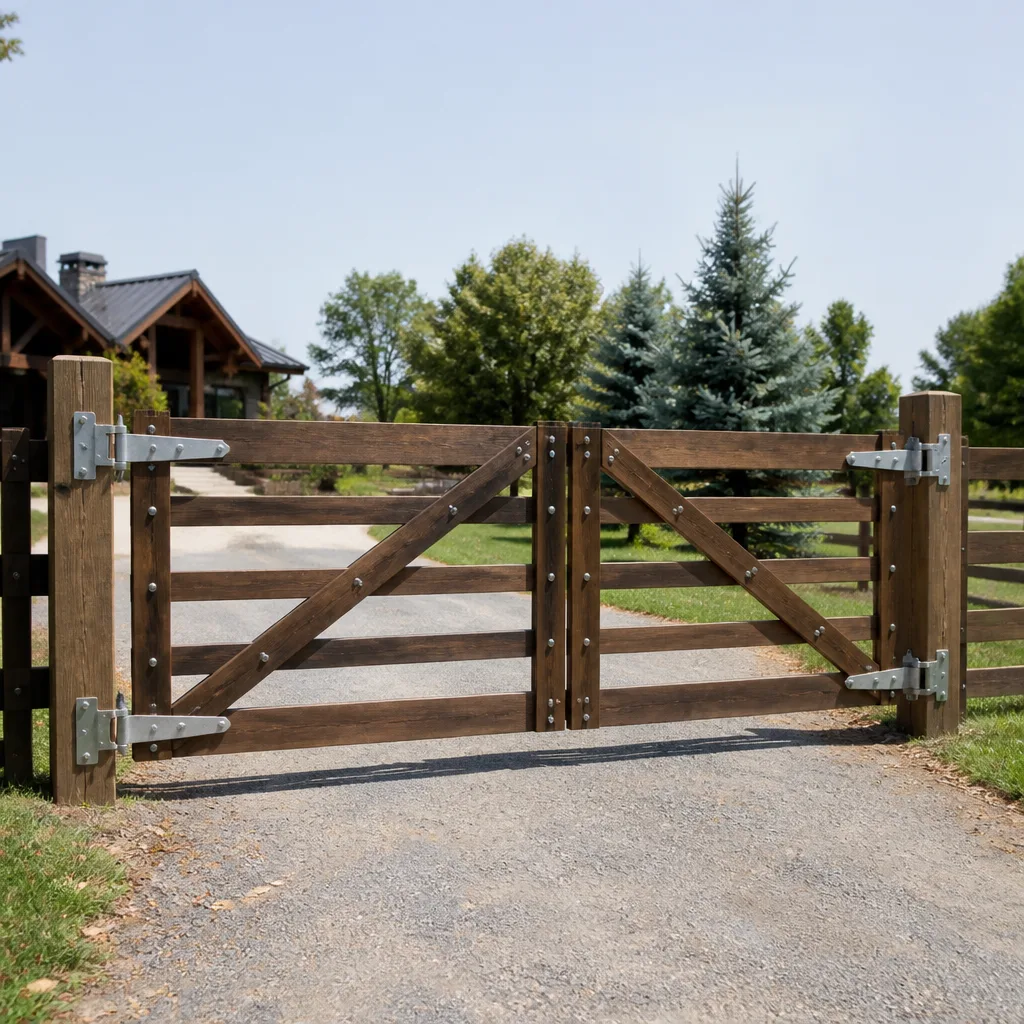 Farm & ranch
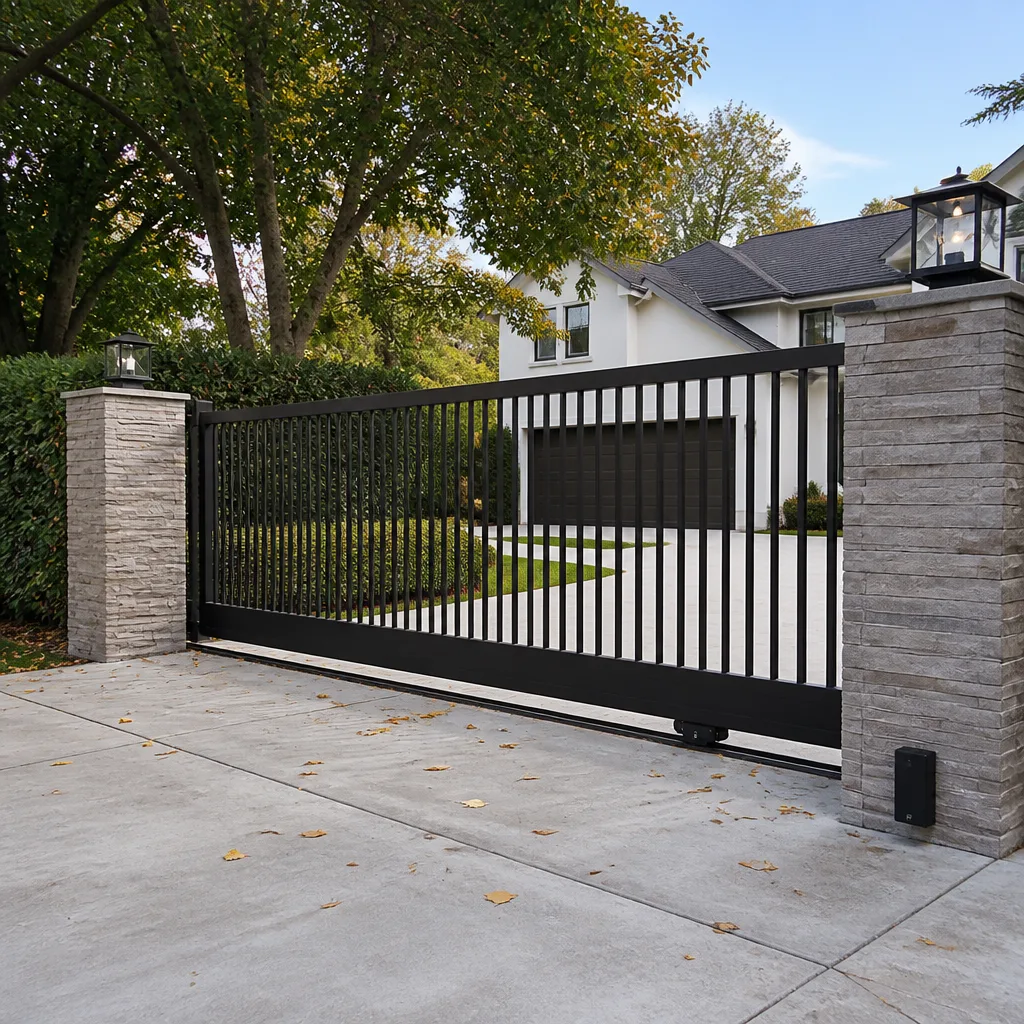 Sliding driveway gates
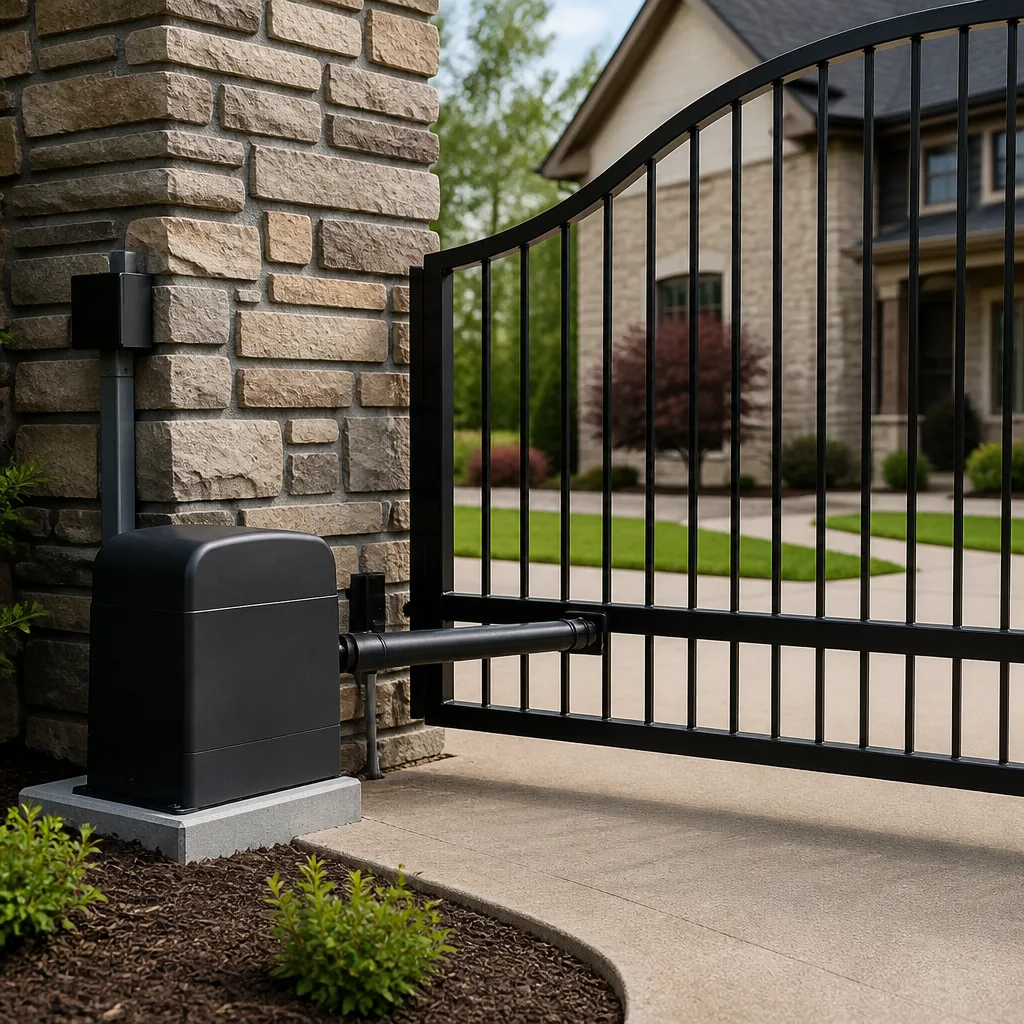 LiftMaster operators
Free on-site gate assessment - hinges, posts, and your LiftMaster or Nice gate operator checked before anything is quoted
The assessment is free and the quote is the invoice.
Get your free estimateGate Repair Permits, Codes & Inspections in TX: What You Need to Know
A City of Austin inspector can issue a stop-work order on a gate project that started as a simple post replacement the moment you change the opening width by even six inches. That counts as a structure alteration, not a repair, and it flips the job into permit territory without most Austin homeowners realizing it. This guide draws that line clearly so you aren’t standing in your driveway with a half-mounted gate, a red tag, and a contractor who suddenly wants to charge extra to fix the paperwork. We’ll cover the specific Austin code thresholds, HOA deed restrictions, Travis County ETJ rules, and what happens to your insurance if a permit gets skipped.
Quick Answer
Most straight gate repairs in Austin, TX do not require a permit: swapping a hinge, replacing a wheel, rewiring a photo-eye, or installing a new circuit board on an existing operator falls under routine maintenance. A permit is generally required when the project changes the structure itself: replacing or resetting posts, widening or narrowing the gate opening, raising the gate or fence height above code limits, or adding an electric operator to a gate that was previously manual. When in doubt, call the City of Austin Development Services Department before the first hole is dug because the cost of the permit is always less than the cost of a stop-work order.
Styles & brands we work with
Table of Contents
- Repair vs. Alteration: The Permit Line in Austin
- Austin Fence & Gate Code: Heights, Setbacks, and Sight Lines
- Electric Gate Operator Permits: A Separate Application
- HOA Deed Restrictions vs. City Code: What Governs When They Conflict
- Travis County and the ETJ: The Rules Outside Austin City Limits
- What Happens When a Contractor Skips the Permit
- The Inspection Process: What an Austin Inspector Actually Checks
- Permit Costs and Timelines in Austin
Repair vs. Alteration: The Permit Line in Austin
The City of Austin draws a specific line between maintenance and modification, and understanding that line is the single most useful thing you can do before starting any gate project. A repair restores the gate to its original condition without changing its dimensions, height, materials, or operational characteristics. An alteration changes any of those things. The distinction matters because the City of Austin does not require a permit for routine repairs, but it does require a development permit for structural alterations to fences and gates under the city’s Land Development Code.
Work That Generally Does NOT Require a Permit in Austin
- Replacing a bent hinge or a rusted wheel on an existing sliding gate
- Swapping out a failed circuit board, remote receiver, or photo-eye sensor on an existing operator
- Replacing the actuator (the motorized arm that physically pushes a swing gate open) with a unit of the same physical footprint and mounting points
- Reattaching a gate that has sagged but whose posts remain solid and in their original position
- Replacing hardware like latches, locks, keypads, or loop detectors
- Lubricating, adjusting, or re-tensioning existing hardware
Work That Generally DOES Require a Permit or Development Review
- Replacing one or both gate posts because the originals failed
- Moving a post to widen or narrow the gate opening, even by six inches
- Raising the height of the gate or the adjacent fence section
- Installing a new gate where no gate previously existed
- Adding an electric operator to a manual gate (this is the one homeowners miss most often)
- Changing the gate material in a way that alters its structural design, such as converting a chain-link frame to a steel panel gate on the same posts
In our experience, the post replacement rule is where Austin homeowners get caught most often. A post rots at ground level, the homeowner calls a handyman, the handyman digs out the old post and sets a new one in concrete, and the job gets flagged because the new post is set six inches to the left to dodge a root. That’s a new opening dimension, and the inspector treats it as an alteration, not a repair. For a full picture of what counts as a routine repair in this market, our Gate Repair in Austin page covers the specific services that don’t trigger permit review.
Austin Fence & Gate Code: Heights, Setbacks, and Sight Lines
The City of Austin regulates fences and gates primarily through the Land Development Code, specifically the sections addressing residential design standards. The most commonly cited restriction is height: in most single-family residential zones, a fence or gate in the front yard cannot exceed 4 feet, and in the side and rear yards it generally cannot exceed 8 feet. But Austin’s code has nuances that a surprising number of contractors never mention.
Key Austin Height and Placement Rules
- Front yard: Fences and gates are generally limited to 4 feet in height. This includes any gate across a driveway in the front setback.
- Side and rear yards: Up to 8 feet is typically allowed, but corner lots have extra restrictions because of visibility triangles at intersections.
- Visibility triangles: At any driveway or street intersection, Austin requires a clear sight triangle. A solid gate taller than 4 feet positioned too close to the street corner can violate this, and the city can require it be moved or shortened.
- Pool gates: If the gate is part of a pool barrier, the City of Austin enforces additional safety rules, including self-closing and self-latching mechanisms and minimum height requirements that often exceed the standard fence code. Pool barrier gates are inspected under the city’s pool code, not just the fence code.
- Historic districts: Homes in designated historic districts (Hyde Park, Old West Austin, Bouldin Creek, and others) may be subject to additional review by the Historic Landmark Commission. A gate replacement in these neighborhoods can require design review even when the same project in North Loop or Brentwood would sail through.
The height rule is especially relevant for driveway gates, which are often installed at the front property line. A 6-foot driveway gate that looks proportionate to the house might be 2 feet over what the front setback allows, and the city can require it to be cut down or removed. This is one reason we always check the setback before quoting a new driveway gate installation. Our Gate Installation in Austin page walks through the full planning process for new gates, including the code checks we run before any concrete gets poured.
Electric Gate Operator Permits: A Separate Application
Here’s a distinction that almost no Austin homeowner knows going in: the structural permit for the gate and the electrical permit for the operator are two different applications, processed through two different review paths at the City of Austin. The gate itself falls under development review. The operator, because it involves low-voltage or line-voltage electrical work, falls under the city’s electrical permit requirements. If you’re adding an electric operator to an existing manual gate, you may need both: a development permit for the structural change of adding the operator pedestal or bracket, and an electrical permit for the wiring and the operator itself.
If the operator connects to household power at 120 volts, the electrical permit is non-negotiable. If the operator is a low-voltage solar unit, the electrical permit requirement can be lighter, but the development review still applies if the gate structure is modified. And Austin requires that electrical work be performed by a licensed electrician or a licensed contractor pulling the permit. A handyman who “knows gates” but doesn’t hold the right license cannot legally pull an electrical permit in Austin.
Six-Step Sequence for Adding an Operator to an Existing Gate
- Confirm the gate posts and hinges can carry the additional load of an operator. A post that’s fine for a manual gate may need to be reinforced or replaced, which triggers the structural permit question.
- Determine the power source: 120V line voltage, a low-voltage transformer, or a solar panel with battery backup. Line voltage requires an electrical permit and a licensed electrician.
- Check the operator’s physical footprint. A pad-mount operator for a sliding gate requires a concrete pad, which is a development change. An arm-mount operator on a swing gate may not require structural work if the posts are adequate.
- File the electrical permit application with the City of Austin Development Services Department if line voltage is involved.
- Install safety devices: photo-eyes, edge sensors, or entrapment protection. UL 325 compliance is a standard requirement for automatic gate operators, and Austin inspectors check for it on final inspection.
- Schedule and pass the final electrical inspection before the gate is put into regular operation.
We service nine major gate-operator brands, including BFT, Linear, Viking, and Ghost Controls, and we’ve seen the full range of operator installs across Austin. The ones that pass inspection on the first visit are almost always the ones where the permit question was answered before the first wire was pulled. The ones that fail are the ones where the operator was installed first and the permit was an afterthought. If you’re dealing with an existing electric gate that’s acting up, our Electric Gate Repair in Austin page covers the common failure points and what they cost to fix.
HOA Deed Restrictions vs. City Code: What Governs When They Conflict
HOA deed restrictions and city code are two different legal layers, and they don’t talk to each other. The City of Austin inspects for compliance with the Land Development Code. Your HOA enforces its own covenants, conditions, and restrictions, which are recorded against the deed. A gate can pass city inspection and still violate your HOA’s design guidelines, and the HOA can demand changes to a gate the city has already approved. The reverse is also true: an HOA architectural committee can approve a gate style that the city would flag for a sight-line or setback violation.
In the Austin suburbs, where HOAs are prevalent in newer developments like Steiner Ranch, Avery Ranch, Circle C, and Shady Hollow, the HOA layer is often stricter than the city layer on matters of aesthetics: gate color, material, ornamentation, and even the type of opener. The city layer is stricter on matters of safety and structure: height at the front setback, distance from the street, electrical code compliance. When the two conflict, the stricter of the two applies in practice, because either entity can force a change. You have to satisfy both, not just one.
What to Check Before You Start
- Pull your HOA’s architectural guidelines from the management company or the HOA website. Look for the specific sections on fences and gates.
- Submit an architectural modification application if your HOA requires it. Many HOAs in Austin require written approval before any exterior change, including gate replacement.
- Check Austin’s Land Development Code for the height and setback rules that apply to your specific lot type and zone.
- If the gate is part of a shared fence line or driveway with a neighbor, verify the property line and any recorded easements. A gate installed over a utility easement can be ordered removed.
- Keep the written HOA approval and the city permit in the same folder as your gate warranty paperwork.
We’ve worked with HOAs across the Austin metro, and the approval timeline varies enormously. Some architectural committees turn applications around in a week. Others take six weeks and meet only monthly. That’s not a reason to skip the HOA review; it’s a reason to start it early.
Travis County and the ETJ: The Rules Outside Austin City Limits
Travis County has its own development regulations, but they differ significantly from the City of Austin’s. If your property is outside the Austin city limits but inside the extraterritorial jurisdiction (the ETJ, the unincorporated land the city reserves for future annexation), you are generally governed by Travis County rules, not City of Austin code, for building permits. That’s a critical distinction for homeowners in places like western Travis County, the area around Lake Travis, and developments on the county’s edges.
Travis County historically took a lighter regulatory approach to fences and gates than the city does. For years, Travis County did not require residential building permits at all for most single-family work, though that has changed in recent years with new development rules. The county now issues permits for certain residential construction in unincorporated areas, but the fence and gate thresholds are not as detailed as Austin’s Land Development Code. The practical takeaway: if you’re in the ETJ, don’t assume Austin’s rules apply, and don’t assume no rules apply. Call Travis County’s Development Services Department and confirm.
There’s an additional layer worth mentioning: some properties in the ETJ are served by a municipal utility district or a water control improvement district that has its own covenants. Those districts can impose architectural standards that function like an HOA. And if your property is in the Lake Travis area, the Lower Colorado River Authority may have setbacks or shoreline rules that affect fence and gate placement near the water.
What Happens When a Contractor Skips the Permit
Here’s the scenario that costs Austin homeowners more than any other, and it’s one of the key Gate Repair Warning Signs: A Austin Homeowner’s Reference Guide covers: a contractor quotes a gate project, says “we don’t need a permit for this,” and completes the work without one. The work is done. The check is cashed. And then one of three things happens.
First, the city finds out. Maybe a neighbor complains, or an inspector in the neighborhood for a different job notices the new gate and checks whether a permit is on file. The city issues a stop-work order if the project is ongoing, or a notice of code violation if it’s done. Either way, the homeowner, not the contractor, is ultimately responsible for resolving the violation, and the resolution often involves submitting plans after the fact, paying double permit fees, and in some cases redoing work that wasn’t photographed or inspected during installation.
Second, the homeowner’s insurance company finds out. If a gate installed without a required permit later causes damage, say a windstorm rips an improperly anchored gate off its track and it hits a car or a person, the insurance company can deny the claim on the basis that the work was completed without required permits. The claim denial can extend beyond the gate damage itself to liability claims arising from the incident. The homeowner is then left holding the full cost of the damage plus legal exposure.
Third, the homeowner tries to sell the house. A buyer’s inspector or lender may flag the unpermitted gate work during due diligence. The seller is then forced to either obtain the permit retroactively or credit the buyer for the cost of bringing the work into compliance. In a city like Austin, where the real estate market has been competitive for years, unpermitted work is a sale-killer that never shows up until the worst possible moment.
Our position is simple: if a gate project needs a permit, we pull the permit. The permit fee is a line item on our written quote, before any work starts, so there’s no surprise at the end. Every Portcullis Gate Repair Austin job comes with a written price before a single bolt is turned, and that price includes all required permits and inspections. It’s part of the Kingswell Guarantee, which also includes a real arrival window and a clean job site.
The Inspection Process: What an Austin Inspector Actually Checks
If your gate project does require a permit, the City of Austin inspection process follows a predictable sequence. Understanding what the inspector checks can save you from a failed inspection and a rescheduling fee. Here’s what typically happens, in order.
- Permit issuance: The application is reviewed by the Development Services Department. For simple fence and gate projects, this is often an over-the-counter review. For projects in historic districts or floodplains, the review can take substantially longer.
- Pre-installation inspection (if required): For projects involving new concrete footings or post foundations, the inspector may need to see the excavated holes before concrete is poured. This confirms the footing depth and diameter meet code.
- Framing or rough-in inspection (electrical only): For electric gate operators, the inspector checks the wiring run before it’s covered by conduit or buried. This confirms the wire gauge, the conduit depth, and the grounding.
- Final inspection: The inspector walks the completed project and checks the gate height, the setback, the post depth, the operator safety devices, and the general condition of the installation against the approved permit documents.
- Certificate of completion: Once the final inspection passes, the permit is closed and a certificate is issued. Keep this document. It’s the proof you need if a future buyer or insurance company asks whether the work was permitted.
One thing that surprises Austin homeowners: the inspector is checking against the approved plans, not against an idea of “good workmanship.” If the plans say the gate is 60 inches tall and the installed gate is 66 inches, it fails, even if the installed gate is better built than the one on the plans. Changes after permit approval require a revised application. It’s slower and more expensive than getting the plans right the first time.
Permit Costs and Timelines in Austin
Permit costs in Austin are not a mystery, but they vary by project type. A basic residential fence and gate permit application typically runs between $100 and $400, depending on the valuation of the work and the specific review path. Electrical permits for gate operators usually add another $150 to $500. The permit fee is based on the project valuation, so a full gate replacement with new posts and a new operator will have a higher permit cost than a simple post repair.
Timelines matter as much as cost. A simple over-the-counter fence and gate permit in Austin can be issued in as little as a day or two if the application is complete and the plans are clear. Projects that require a site plan review or a historic landmark review can stretch into weeks. Our advice: assume two to four weeks for the full process, from application to final inspection, for a project that includes structural changes plus an electric operator. If your gate is down and you need it working now, a temporary fix can often be done under a repair exemption while the permit for the permanent work is in review.
Here’s the important part, and it’s the reason we put it in writing on every quote: the permit cost and the inspection fees are included in our written price. You see the total before we start, and the number you approve is the number you pay. That’s the Portcullis Gate Repair Austin way, and it’s how we’ve operated as an independent Kingswell company in Austin since 2008.
Common Mistakes to Avoid
- Assuming every gate project needs a permit: Routine repairs don’t. Paying for a permit you don’t need wastes money, but it’s far less expensive than skipping one you do need. When unsure, call Development Services and ask.
- Assuming no gate project needs a permit: This is the more expensive mistake. Austin homeowners regularly get stop-work orders for post replacements that changed the opening width.
- Skipping the HOA review because the city said yes: The city doesn’t enforce your HOA’s covenants, and your HOA doesn’t enforce city code. Both approvals are required, and neither covers the other.
- Letting an unlicensed handyman pull wire for a gate operator: Austin requires licensed electricians for line-voltage electrical work. If the permit lists a licensed contractor, the work must be done by that contractor or under their direct supervision.
- Putting off the permit until the work is done: After-the-fact permits are available in Austin, but they come with fees that can be double the original permit cost and often require more invasive inspection of work that’s already covered by concrete or trim.
- Losing the permit paperwork: The closed permit and final inspection certificate are proof of compliance. Without them, a future buyer or insurer may treat the work as unpermitted.
- Not checking the front-yard height limit before installing a driveway gate: The 4-foot front setback rule catches more Austin homeowners than any other single code provision.
See the difference
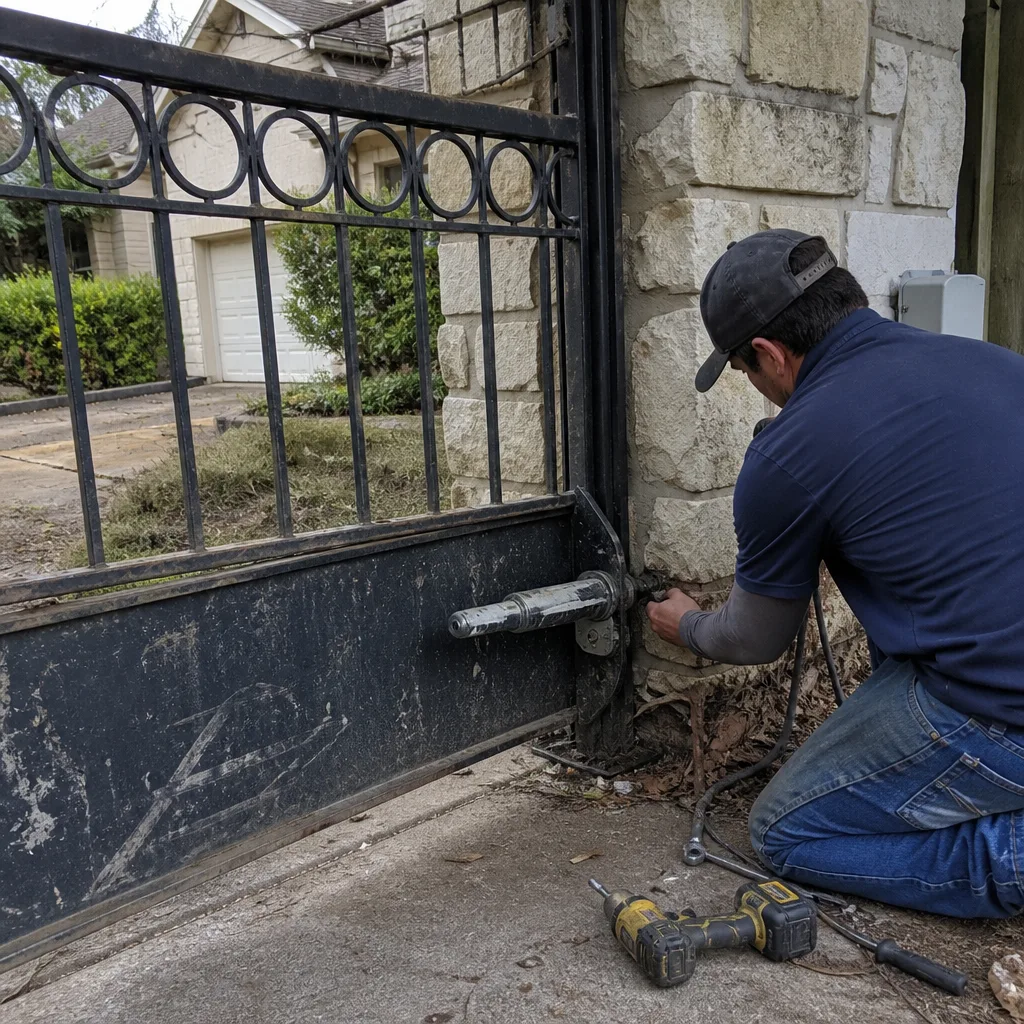 Before
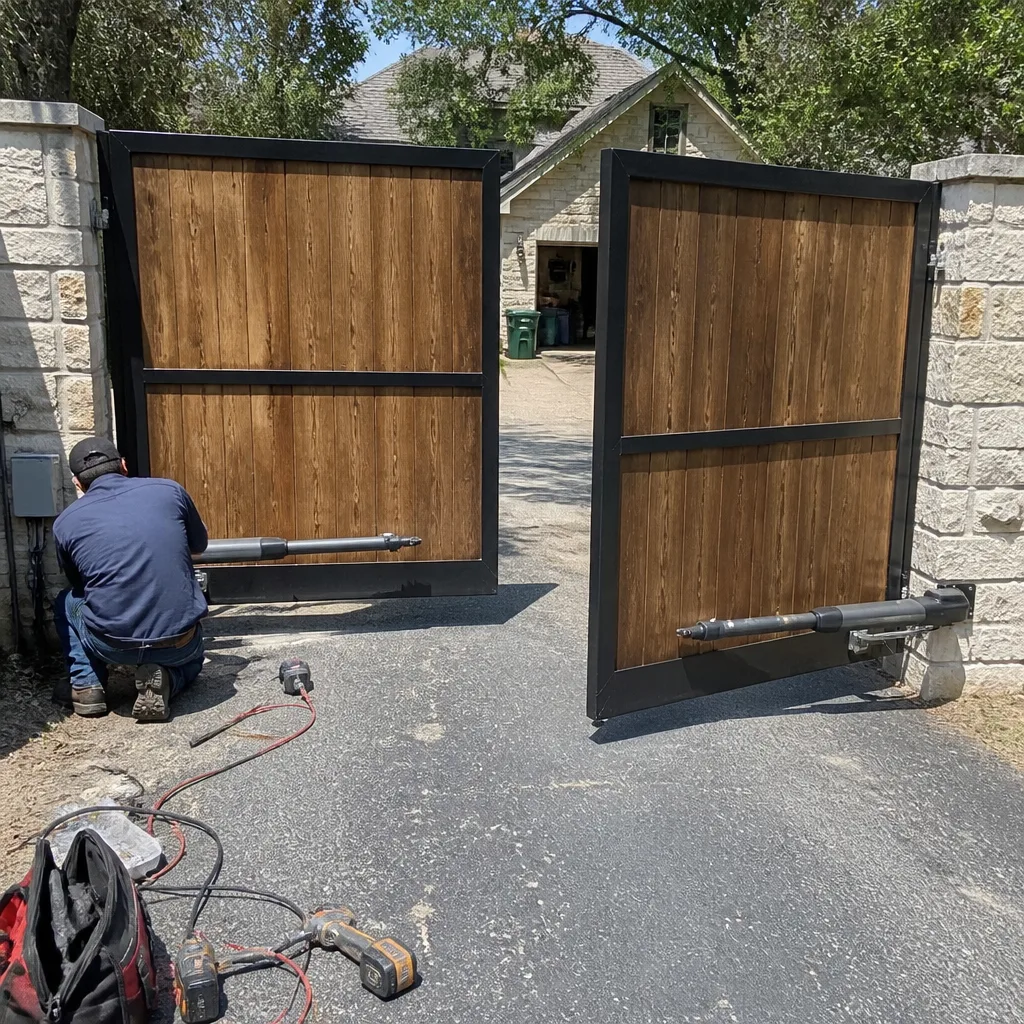 After
After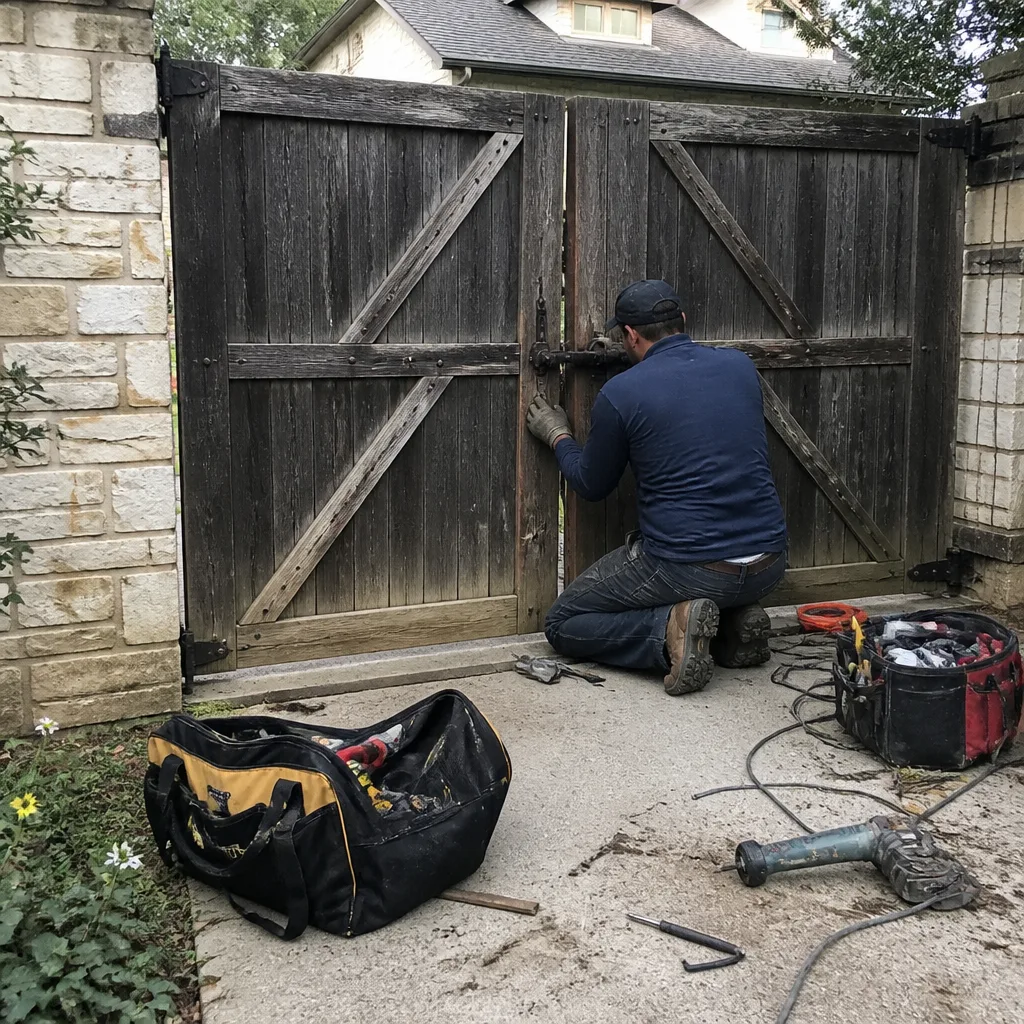 Before
 After
After Before
 After
AfterWhen to Call a Professional
Austin gate repair ranges from a 20-minute hinge swap to a two-week structural project, and the permit question usually tells you which one you’re facing before the work even starts. If the job involves replacing a post, widening an opening, adding an operator, running line-voltage wiring, or touching a pool barrier, you’re in territory where a mistake costs real money to fix and can hang you up at a future home sale. Portcullis Gate Repair Austin offers free estimates in Austin and we’ll tell you honestly whether your project needs a permit. Call (254) 280-0629 and we’ll give you a written quote that includes any required permits, so there are no surprises. You can also start with our Portcullis Gate Repair Austin home page to see the full scope of what we do.
Frequently Asked Questions
No permit is required in Austin for routine gate repairs that restore the gate to its original condition without changing its dimensions, height, posts, or operating system. Swapping hardware, replacing a circuit board, or installing a new hinge are all permit-exempt repairs. A permit is required when the work changes the structural elements, such as replacing a post, moving an opening, raising the height, or adding an electric operator to a manual gate. Call (254) 280-0629 if you’re unsure which side of the line your project falls on.
A basic residential fence and gate permit in Austin typically costs between $100 and $400 depending on the project valuation, and an electrical permit for a gate operator usually adds another $150 to $500. The total depends on the scope of the work listed on the application. Every Portcullis Gate Repair Austin quote includes the permit fees as a line item, so the price you approve in writing is the price you pay.
Generally no. Replacing a gate post is considered a structural alteration under Austin’s Land Development Code, not a routine repair, and it typically requires a development permit. The inspector’s main concern is that the new post matches the original location and dimensions; if you move the post even a few inches to one side, you’ve changed the opening and may need a revised review.
In most Austin single-family zones, a gate in the front yard or front setback cannot exceed 4 feet in height. Gates in the side and rear yards can generally be up to 8 feet, but corner lots have additional visibility triangle restrictions. If your driveway gate is in the front setback, plan for a 4-foot maximum unless you verify otherwise with the city.
Yes. An operator that runs on 120-volt line power requires an electrical permit from the City of Austin in addition to any structural permit for the gate itself. Solar-powered low-voltage operators may not require an electrical permit, but the structural work still falls under development review if posts or mounting pads are involved. UL 325 safety devices are required on final inspection.
You can be required to obtain an after-the-fact permit, which carries higher fees than an original permit and often requires the work to be unwrapped for inspection. The violation can also complicate a future home sale or insurance claim. The best resolution is to file the after-the-fact application promptly and have a licensed contractor bring the work into compliance, which we do regularly for Austin homeowners. Call (254) 280-0629 for a free assessment.
The Bottom Line
The permit line for gate work in Austin comes down to one question: does the project change the structure or just restore it? Routine repairs like hinge replacements, board swaps, and track adjustments don’t require a permit. Post replacements, opening changes, height increases, and operator additions generally do. HOA review sits on top of city review, Travis County rules apply outside the city limits, and skipping any of these layers creates liability that can follow you into a home sale. For more guides & resources on navigating these requirements, explore our blog. The cheapest insurance against all of it is a written price from a contractor who pulls the permits and stands behind the work. That’s what we’ve done at Portcullis Gate Repair Austin since 2008.
Written by Dean Prescott, Owner at Portcullis Gate Repair Austin, serving Austin since 2008.